

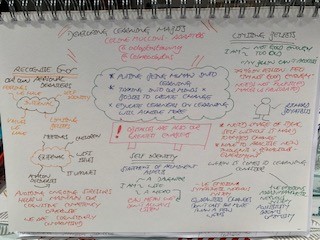
For International Leadership Week ILM hosted a series of webinars with a worldwide perspective. Regular readers will know that I like to reflect on my learning through blogging so here it is – some ruminations on International Leadership Week.
For context I attended the following sessions:
- Get Out of Their Way – Curt Blattner (Institute of Emerging Change)
- Can I be a Mindful and Enterprising Leader Simultaneously? – (Shilpi Chugh Head of HR Dyson)
- How to Push Yourself Out of Your Comfort Zone – Ricardo Koanuka
- How to Reinvent Leadership by Empowerment – Aslak de Silva, CEO at Nordic Business Forum
- How to Manage the Changing Workplace – Audrey Clegg Group Talent Manager Coca Cola
- Remote Leadership and Asynchronous Management – Molood Ceccarelli (Remote Forever)
- From a Doing Leader to a Being Leader – Harini Chari
- Leading in a Complicated World – Marco Buschman
- The importance of data in Business Growth – Manuj Aggarwal
And below are the themes I have been thinking about:
- As Chugh put it ‘The World has Changed and How’ – which featured
- Chaos and high turbulence with ambiguity and no cause and effect relationships. The human brain is threatened by ambiguity and when this happens human beings move to the lowest level of Maslow (security and safety)
- A higher need for a collective intellect as we are trying to solve issues – Information is a commodity and mass collaboration is the key. When the world went virtual there was a huge adoption of virtual tools and we tended to collaborate in our own networks which was relatively comfortable.
- A need for enterprising Leadership – when there is a question of business survival the need for control is higher. We also need empathetic leadership in the hour of need as people are impacted at a personal level.
- Global social networks are more prominent than ever before when the world went virtual.
- Remember that you can learn as much from a crisis – As Clegg put it “Never waste a good crisis”. She also noted that when she was asked to draw her career on her A4 piece of paper every 10 years there was a crisis and asked to remember that this is a learning opportunity.
- Leaders have a far and wide ranging impact – Chugh highlights that leaders and leadership raises the collective consciousness of the organisation and Chari took this one step further and talked about having a leadership brand. She went on to say that this brand is made up of a million touches and that when we change someone’s lives this creates an emotional connection. Chari also highlighted a good question to ask ‘What are the after effects of me?’
- There is also an impact on leaders as well – 77% of leaders reported that stress was significantly higher (cited by Chugh)
- The need for Leaders to have a clear purpose is more important than ever – Koanuka suggests that the leader of the future understands the power of purpose which Chari refers to as our inner compass. Koanuka goes on to explain that we need more than purpose, we also need action – “Purpose without action is hallucination”. Some useful statements were offered to check whether you are aligned with your purpose – you either choose on or the other from those below
| Make choices based on courage/adventure | Make choices based on fear or security |
| Best day is Friday night | Worst day is Sunday |
| Already thinking about retirement | Love what you do so retirement feels stupid (based on Warren Buffet) |
| Do you feel pushed to go to work? | Do you wake up ready for work full of excitement? |
| Success is money/power | Success is creating a life on your own terms |
- Reflective Practice by Leaders is Key – As Chugh notes “When we are mindful we operate from a space of awareness – how as a leader am I increasing my awareness of knowing myself.” Chari’s session highlighted how quite often we are working in a driven doing mode and we need to move to a being mode and focus on being present in the moment. The difference between the two is highlighted in the graphic below

- Relationships are fundamental to success – Blattner highlights the need to use the time at work to build high performing sustainable relationships through the use of constructive dialogue. There are also a number of skills associated with this as Clegg highlights including using listening combined with empathy to really understand what is going on in people’s lives. Aggarwal reminds us that we are designed to remember emotions not facts and figures which suggests this is what we should focus on.
- Consistency is the key – Across teams, leaders and indeed the whole organisation as De Silva notes “It’s the seamless experience across functions and customs which make the difference.” For leaders it is about thinking of the consistency of actions. For teams it is important to harness what Blattner calls ‘Psychological energy’ across the team – effectively this is concerned with harnessing the team’s effort to focus on what’s important. He then goes on to outline 3 steps which are important within this
- Asking ‘What’s the weather inside?’ – invites people to share their pre-occupations and becomes a ritual and enables the team to focus on what they need to do.
- Having a cooperation contract within the team which enables a ritualised high quality discussion on how the team will work together and creates a one unit team.. Also suggests a mission contract which focuses on objectives
- Having a Vision contract which normally sits within the Leaders domain. Here it is suggested as actually working in partnership with the team.
- Flexibility is still important – Buschman stresses the importance of context and suggests using the Cynefin model for effective problem solving at the moment which helps to identify clearly what this is.
- Empowerment builds successful teams – De Silva explained that this looks like in practice – empower your employees effectively through delegating, lead by example, build the big picture and give feedback using a feed forward approach. (positive feedback for things that have been completed well)
- Trust is still a key underlying theme – As Clegg notes “Trust is fundamental to any relationship including personal” and she explains that the key question is “Can I be authentic and can I be my real self at work?” De Silva takes this further and suggests that we need to have trust in the team’s motivation (that they are coming from the right place) and trust in their skills. He goes on to describe how this should be reflected in the language we use with our teams “I trust you, I chose you, I am so pleased you are in my team.”
- Effective Remote Leadership is still a Work in Progress – Ceccarelli suggests four pillars of remote leadership as outlined below
- Using Asynchronous Communication – Stressed as the most important aspect. You need to choose the right communications for the purpose you are trying to make. For great decision making and resolving conflict use synchronous for example online meetings and chat which is an exchange of information in real time. Whilst Asynchronous – for example email – gives people the choice to respond when they can do and is great for sharing and gathering information. Ceccarelli also suggests simplifying the tools we use by writing down the names of all the tools you use daily and group them based on purpose. In each tool write down one tool you are going to use and retire the others.
- Transparency – which needs to go two ways and it is important for leaders to be transparent on what they are working on too.
- Consider Diversity, Inclusion and Empathy – Remember that not everyone has access to decent bandwidth and there need to be a stable infrastructure IT system to enable remote working
- Use a Continuous Learning Approach – Think about your time management and respect your calendar. Create boundaries and use different devices for home and work. Think about your self care and movement. For example, have digital disconnection, human reconnection and exercise. Buschman builds on this idea and talks about making sure we have the energy to lead.
This was a great event and there were lots of deep learning here for me especially thinking about
- What are the after effects of me?
- Being more respectful of my diary and not letting others take it over – this is one of the things I really need to work on and is definitely a work in progress for me.
- Moving from a driven mode to a being mode
- Thinking about what types of communication to use and when
What are you going to take away and do differently as a result of reading this?



 Ramblings of a L&D Professional